Saturday, April 21, 2012

Elephant Riding

On April 14 I rode an elephant.

Britt and I rented another car and went back to Kwantu for our rain-checked elephant ride. We did not get lost this time! w00t! We rode the elephants for about 30 minutes and then were able to feed them, all four of them, tasty treats. There is no way that I can explain how cool it was to ride and feed elephants. Hopefully the photos can give you some idea...
Elephants are matriarchal which means that they are lead by a dominant female.  A majority of the elephants in a herd will be female with the exception of a few immature males. The mature males go out on their own only coming around to mate.

Elephants carry their babies for approximately 22 months.

Elephants in the wild live up to approxiately 75 years while elephants in sanctuaries, like Kwantu, can live up to 100 years. In sanctuaries they are protected from the elements, given vitamins and healthy foods to supplement their diets, and tended to when sick. 
Our guide said that training elephants is similar to training dogs: they use a lot of treats to form habits. As the elephants were coming out to play the guide called out random commands, "right," "left," "forward" and "stop." The elephants followed each of the commands perfectly. It was pretty cool. You could tell they each had their own personality. The gal on the middle right kept trying to get food out of the middle left gal's mouth. They were smacking each other with their trunks.
Here we go! My elephant was Lacey. She was gorgeous.
The elephant's skin was rough. I was warned that their skin was very coarse (hence the long pants) but wasn't imagining it the way it actually felt. Imagine the way that a callous feels. Now imagine that texture covering the enormous body of an elephant. That is exactly how their skin felt. Though their body is covered in callous-thick hide, behind their large ears is satin-smooth (I felt them, so I can vouch for this piece of info!). They have hundreds of blood vessels behind their ears which they use as fans on hot days. These keep the skin here tender and smooth.
Did you know that though elephants are gigantic creatures they can sneak up on people? They do not stomp around like we teach our kids... they walk very gently. Also, elephants can send information to other elephants through the vibrations in the ground. They can feel vibrations from up to several kilometers (even more miles) serving as warnings, information about herds, predators, etc. 

FAVORITE PART: I got to FEED the elephants!!!!
I was so excited I couldn't even stand it!

Reeeeeeeeeach.
We could put the food directly in their mouths (sticky, hot and stinky-- but fun!), or in their trunk---> they would feed themselves that way.

This gal had ants in her pants. Super impatient elephant alert.
P.S. I got hit in the head by her trunk because she couldn't wait for her goodies.
"Quick. Staring contest. You. Me. Now."
Britt putting food in the elephants trunk.
Their trunks were amazing. Elephants have "fingers" on the ends of their trunks. We dropped quite a bit of food on the ground. Getting the food in their mouths was a bit tricky. I didn't want to get chomped. No matter, the elephants used the fingers on the tips of their trunks to pick up the treats. Did you know that elephants have "fingers?" They do.
There isn't anything quite like an elephant. They are truly incredible.
"Please don't hit me again, baby girl."


This is where the elephants come to sleep at night. The ceiling has some kind of electrical heating element to circulate heat on cold evenings. The trainers tend to the elephants every day.
Going back to the wild, trainers at their side.

Would I do this again? In a heartbeat. This is by far my favorite South African adventure.

Sarah

Zebras, and Giraffes, and Wildebeest, Oh My!

Over break, Britt and I rented a car and drove to Kwantu Game Reserve for our first ever Game Drive (safari). The GPS took us the wrong way (I think I many have taken a wrong turn...) and we ended up on this crazy dirt road in our little Chrysler Sparklite (refer to previous post for photo of the smallest car ever). It was quite the adventure. Who knew we would be off-roading, 10,000 miles from home, in a clown car? Here is a photo of the road less traveled... seriously...


Due to our ridiculous detour we arrived to Kwantu almost two hours late. Because of that, however, we went on our own personal game drive- which was really cool. We saw zebras, giraffes, wildebeest, tons of deer-like creatures with various names such as bushbok, springbok, blessbok, etc., turtles, mongoose, ostriches and lions. The Kwantu game reserve is huge, home to South Africa's Big Five -- elephants, lions, buffalo, rhinos and cheetah. We spent two hours tracking elusive animals with our guide. There isn't anything quite like being in the wild with some of God's coolest creatures.

Unfortunately for us we didn't get to see elephants, lions (except those that were in captivity), buffalo or rhinos. It was a cloudy and somewhat rainy day and, according to our guide, the animals tend to hide away in the bush on crummy days. Even still, we got to see some really cool creatures-- giraffes and zebras, HELLO!?-- and spend a few hours in the beautiful South African plains. It was a fantastic day.

This was our game drive guide. I cannot, for the life of me, remember his name.
He was a funny and very knowledgeable guy-- been in the animal business for going on 11 years. 

This photo is a bit deceiving... we have already gone on the drive at this point. But we look like we are justing getting ready to set off on the adventure! We had this truck and the guide all to ourselves! 

The African plains. Nothing like it.


We spotted a herd of wildebeest. Our guide told us that when a predator or potential threat are around the entire herd will stop what they are doing, turn and stare in the direction of the threat. I can see why... it was quite intimidating.


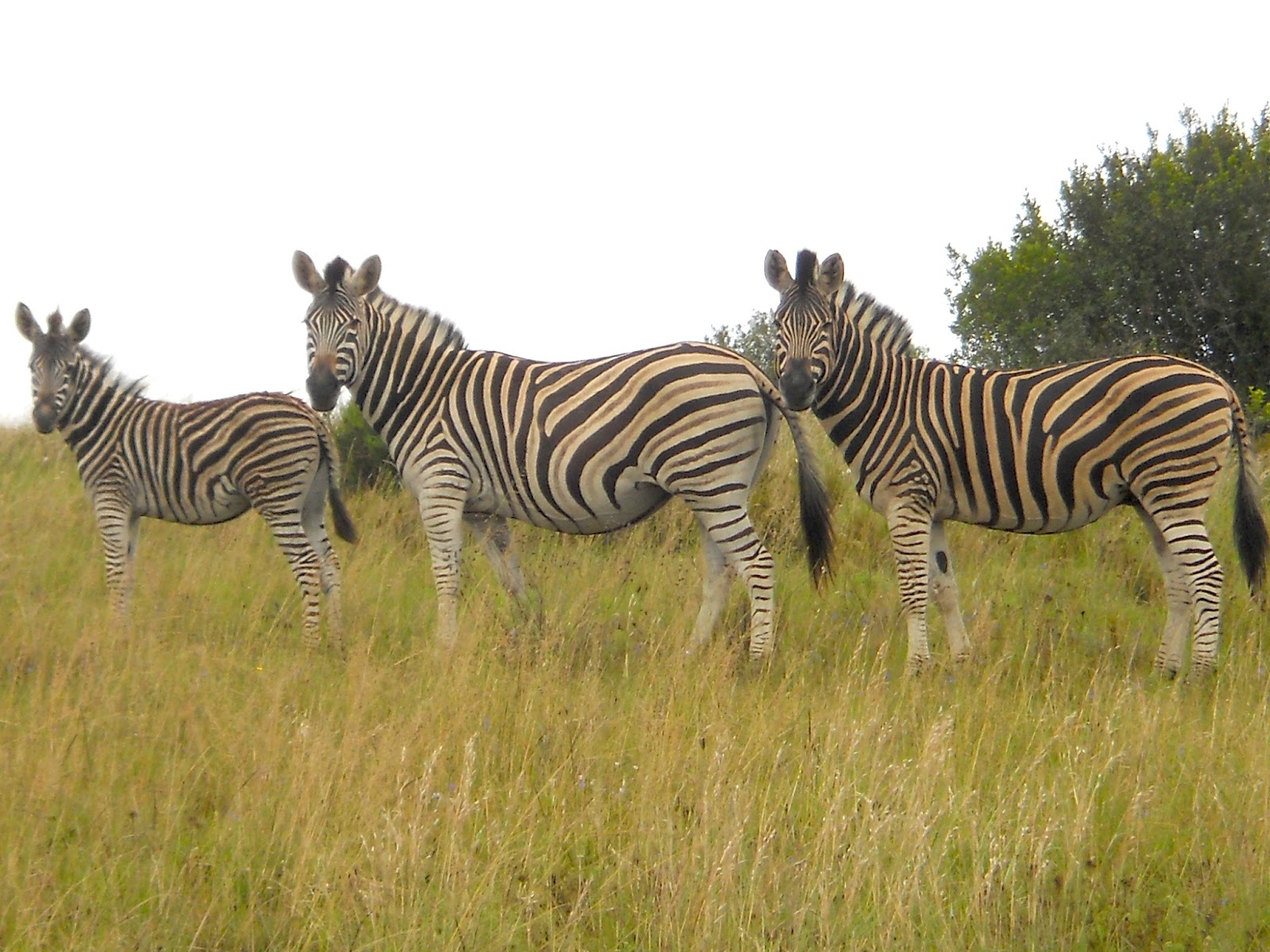
We saw so many zebras during the drive. These zebras are not the typical zebra that we think of (according to our guide). These zebras are Burschell's zebras-- they are specific to the region. You can tell the difference by the stripes. The strips on these zebras (pronouced "ze-bras" --NOT "zee-bras"-- by South Africans) wrap around their bellies and across their bums. Also, there is a brownish-orange shadow strip down the white strips. The baby zebras have orange hair. They are beautiful.


It was a super cold day. We had blankets on the drive! It was probably in the  low 50's. NOT something we are used to in ZA!

Do you see what I see?! Our guide was tracking the lions during our whole trip. We really wanted to see them! Unfortunately, these tracks are all that we saw of the wild lions. Still, pretty incredible, right?

More lion tracks. The reserve has 4 wild lions-- one male, a female and two cubs. They limit the number of lions within the reserve. Why would they do that?

To maintain a proportional predator-prey ratio. Good thinking.

While he was tracking the lions our guide spotted some serious big bugs. I cannot remember what kind of a beetle this is! There were two of them on the side of the road and the guide spotted them right away. Homie has some good eyes.

A little bigger than a quarter. Yikes.

Do you know what this is? We all saw these all over the place out on the plains and in the bush. Britt and I thought they were rocks. Nope. Wrong-o. These are termite mounds. They are gigantic. This one was about four feet tall! Our guide told us that they are about as big underground as they are above ground.

The houses in South Africa are made with cinder blocks and concrete. Why? For two reasons-- 1. The weather is temperate so there is not real need for insulation. There aren't very many houses with AC (not that I have seen, anyway) or heat;  2. TERMITES. There are some crazy termites out here. They could probably eat a house in 24 hours. OK, I may be exaggerating. Look it up to see for yourself how long it would take. I would assume, by the size of these mounds that it wouldn't take much time at all. 

Look what we found when our guide was tracking lions! We came upon a herd of giraffes-- 6 giraffes! Our guide gave us some really cool information about giraffes: male giraffes are very brightly colored. Why? To attract the less-colorful females. There are quite a few animals in nature (a lot, actually) that mate this way: the male is bright and colorful or does colorful/interesting things to attract the female.

Do you know how a giraffe sleeps? Apparently, they sleep for minutes at a time (between 7 and 10) and keep their head up when they are sleeping. 

A giraffe's heart is very powerful, after all, it has to pump blood all the way up that long neck.

We passed this right before we spotted the giraffes. This is a seventeenth century inn-- built in the 1860s. By the looks of it there were probably four or five rooms. This is literally in the middle of nowhere. Can you imagine living in the middle of the bush, with predators like cheetah and lions and your nearest neighbors miles and miles and miles away? That is how the Afrikaners rolled back in those days.

Notice the bark on the trees in this photo and the one above. Elephants eat the bark off of these trees which ends up killing the trees. 

You can see the brownish-orange shadow stripe that I was telling you about.... Zebras are probably my favorite animal. We have such a fun and creative God, eh?

Ostrich eggs - HUGE
We finally got to see some lions! They were in an enclosure, but as beautiful as ever. These lions are young (only a couple of years old). I can't remember where it is they got them from-- the reserve is looking for a place that they can take them so that they can live in the wild.

We had a wonderful time on our game drive! Seeing all of the animals and being in their natural habitats was one of the coolest experiences that I have ever had.

Sarah


Monday, April 9, 2012

Driving on the Other Side of the Road and Zip-lining Over Waterfalls: Just another Thursday in ZA

Wow! Our two week break from school flew by! Tomorrow we go back to school to start a new term at Herbert Hurd. I will be in Mrs. G's third grade classroom for the next three weeks-- learning their ways, teaching some of my own, and getting to know this particular ZA school a little bit better.

This past week, our last week of break, we did some souvenir shopping at a flea market several miles from home, made new friends at a local cafe and rented a car to do a bit of traveling. I have GOT to tell you all about our travels!

In ZA, like most of the world, drivers are seated on the right-hand side of the vehicle and drive on the left-hand side of the road. Also, a majority of the cars in ZA are standard transmission (they have a stick) which requires one to shift with his or her left hand. Renting automatic cars in ZA is mucho expensivo! These differences change the road rules quite a bit for a driver used to hugging the right side of the road, shifting with his or her right hand, and passing on the left. It was QUITE the adventure!

I have made a list of ZA "road rules" that I learned during our trip:

  • When driving on the highway, slower vehicles must stay on the left side of the road and any passing vehicle (highway or not) must pass on the right. Complete opposite of home.
  • There are large shoulders on either side of the road. These are used for passing purposes. On one lane roads and highways, it is courteous to move over onto the shoulder (dangerous too!) to let speedier traffic through. I am not sure of the legality... no one told me it was illegal....
  • Once a car has passed they will turn on their hazards (if they are thankful) as a 'thank-you.' You must either turn on your hazards to "say" 'you're welcome' OR flash your lights at them.
  • The speed limit seems to be optional... at least to a majority of traffic.
  • Speed is calculated in kilometers per hour rather than miles per hour. 1 kph is slower than 1 mph since miles are shorter than kilometers. The typical highway speed in northeast Ohio is 65mph. In ZA, on the Eastern Cape, it is 120kph. 
    • Here is some math for you kids back home: If 1 kilometer = .62 miles, how many miles is 10 kilometers?
  • The paved roads are very nice. I didn't come across any potholes or large bumps (except on the dirt road-- more on that later). I was surprised by the conditions of the roads. I wasn't expecting them to be so great.
  • The McDonald's drive thru is backwards. Yes. Backwards. Think about going in the out and out the in... that is how you do it ZA style. (photo below)
  • There are random road blocks set up intermittently on the highway. Whether or not you have committed a traffic violation you must stop and show your driver's license. Murray (our friend from Freewalker) told us a few weeks ago that road blocks are pretty routine-- to check for unpaid traffic violation fines and/or expired driver's licenses.
  • When a sign says "Do not feed the baboons," you should stay in your car and NOT feed the baboons. You should do some research on baboons and figure out why feeding them would be a bad idea!
  • The Chrysler Sparklite is NOT a 4x4... it does NOT have off-roading capabilities. In fact, it is probably the smallest car in the world.
Away we go! 
A bit nervous to start...
It was so difficult to remember to stay on the left side. And so strange.
120kph = 74.6mph

We had to go through the McDonald's drive thru!
There were some seriously huge mountains along highway N2-- what the locals call "The Garden Route"

On our first trip in the Sparklite we drove to Tsitsikamma National Park-- about two hours southeast of Port Elizabeth. Why were we driving to Tsitsikamma you ask? To zip-line!

Gearing up!
Britt and I are ready to rock!

The waterfalls that we crossed.
  
It went so fast! There wasn't enough time to be scared...


We had an awesome day driving through ZA, flying through her trees and over her waterfalls.


On Friday we took the good 'ole Sparklite off-roading to Kwantu-- a wildlife reserve on the other side of PE. What an adventure that was! I will post more on that tomorrow. Until then... drive safely!!

Peace,

Sarah